
You are preparing a quote when a message arrives: “What time do you open?” Then you confirm an appointment, copy customer details, and remember whom to follow up with. Each task is small, but together they compete with work that can grow your business.
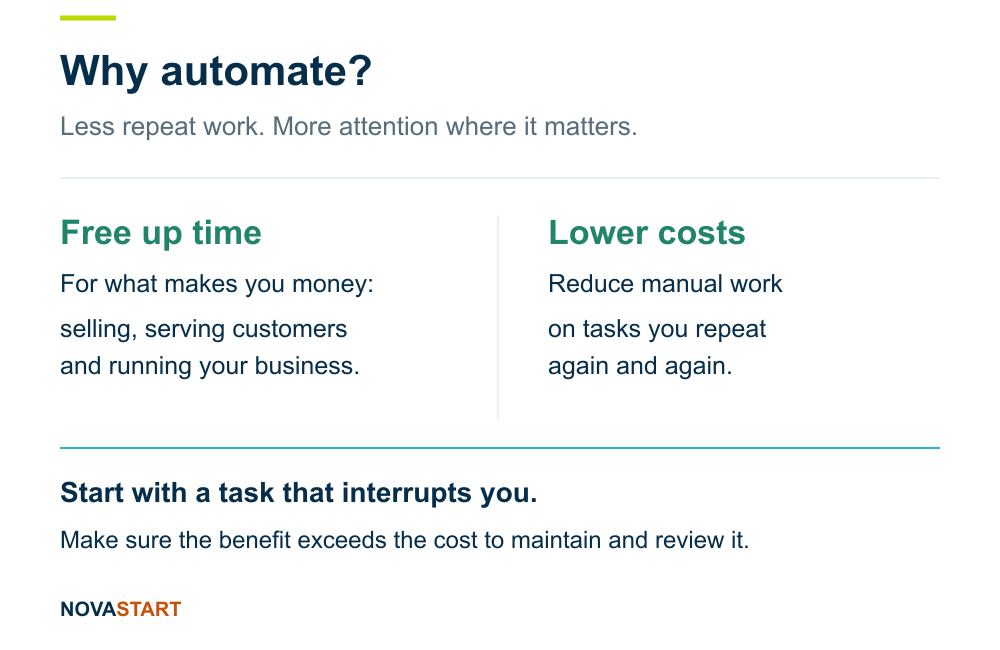
Automation can free time for work that brings in money or reduce repetitive work. For example, it can confirm appointments without requiring you to write each message, or record a request without copying details twice.
If you handle it, it interrupts you. If you leave it, what happens?
Think of a task that frequently interrupts you or feels like it takes too much of your time. If you handle it right away, you may leave a sale, service, or important decision unfinished. If you postpone it, a prospect may go unanswered, an appointment may remain unconfirmed, or a payment may be missed.
That double cost gives you a place to look for an improvement:
| Repeated task | If you do it every time | If it stays pending | What might help |
|---|---|---|---|
| Questions about hours, location, or services | It interrupts your work | The person waits for information | Prepared or automatic answers to common questions |
| Confirming and reminding about appointments | You write and check each one | Appointments can be missed | Confirmations and reminders connected to your calendar |
| Copying details from a request | You repeat work and can make mistakes | The record is incomplete | Move form details into the record you already use |
| Remembering whom to contact | You check chats or rely on memory | A prospect may receive no follow-up | A list with an owner, date, and reminder |
These are examples, not a diagnosis. The right choice depends on your current work and tools.
Start with what repeats and is hardest to leave pending
You do not need to inventory the whole business. Choose one task and answer:
- How often do you do it, and how much time does it take?
- What do you stop doing when you handle it?
- What happens if no one handles it on time?
This gives someone helping you a clear problem description. You do not need to choose the tool or design the solution yourself.
In my commercial work, I started with an Excel sheet to record prospects and follow up. Later, we moved toward a CRM. The need was to see pending work and know what came next. You may only need to organize a record, use a feature you already pay for, or commission a small automation.
How do you know if it is worthwhile?
Compare the benefit with the cost of installing, maintaining, and checking the solution.
If you spent two hours a week on a task and later spend half an hour reviewing it, you recovered an hour and a half. This is an example; measure it in your business. The time may help you serve customers, sell, or lead better. It does not automatically become more money or a lower payroll cost.
Timely work also has value: a confirmed appointment, recorded request, or follow-up that is not forgotten.
Test it on a small scale before relying on it
A first solution should make three things clear: what it does on its own, what a person reviews, and how it alerts you when something goes wrong. It might send an appointment reminder and pass unusual changes to a person.
At first, review real cases. Check that it does not duplicate messages or change important data. Keep a manual fallback. Complaints, special prices, and promises to customers can remain with you.
Then compare: does it take less of your time, are fewer tasks pending, and is the service still good? Expand only after the first task works reliably.
One question to start
Which task interrupts you most, and what happens when you put it off?
Tell us what takes your time and how you handle it today. Novastart can help you analyze the problem and find a practical solution for your business.
Thinking about a vehicle in British Columbia? Review your options with Novastart. Approval and conditions depend on the lender, vehicle, and applicant file.